Monday, March 19, 2007
the Process of my Process
In completing this project I discovered the feelings I had towards my father were a bit different than I had thought they were. I had not given any intensified thought to this, ever. So to sit down and devise a project about these feelings was somewhat revealing parts of myself to me I had not previously acknowledged.

Monday, March 12, 2007


Friday, March 9, 2007
Dad
My father I think is a large source of my creativity. His rigidness sharply contrasted my mothers and I think caused me to think a great deal about several things I would not have had it not been for his presence in my life.
Granted a father is kind of a cop out source. Like it's pretty obvious that a parent is a source of ones creativity but when asked to isolate the most significant source of my creativity, he's the ticket. My dad went to RISD and has his masters from there in Industrial Design and has no money. He's unemployed and lives with my two brothers and stepmother.
Granted a father is kind of a cop out source. Like it's pretty obvious that a parent is a source of ones creativity but when asked to isolate the most significant source of my creativity, he's the ticket. My dad went to RISD and has his masters from there in Industrial Design and has no money. He's unemployed and lives with my two brothers and stepmother.
Monday, February 12, 2007
New Music Video From David "The Hoff" Hasselhoff - "Jump In My Car"
| That's right, it's Hofficial... your favourite cult icon wants to take you home! The one and only David Hasselhoff of "Bay Watch" and "Knight Rider" fame returns with a cover of the 1975 classic 'Jump In My Car' and its a doozy. Recorded in Sydney last year with the legendary Harry Vanda (AC/DC, The Angels), the Ted Mulry Gang tune has been re-vamped with full Hoff gusto and this music video promises to rock the socks off all his Hofficial fans. Watch it, enjoy it, share it on Google Video, courtesy of Sony BMG Australia. Want more? Buy the buy the track on iTunes Australia by clicking here: http://phobos.apple.com/WebObjects/MZStore.woa/wa/viewAlbum?id=155871591&s=143460 | |
Saturday, February 10, 2007
Knock Off
 with a rating of 3.8 out of 10 Hark Tsui's "Knock Off" is the tale of Marcus Ray (Jean-Claude Van Damme) the self proclaimed knock off king of Hong Kong in his adventure of a lifetime. Marcus and his partner Tommy Hendricks (Rob Schnider) discover that their knock off products are being fitted with micro-explosives turning their small time business into big time trouble!
 Jean Claude Van Damme kicks a guy in the head
 The clip i chose reflects the style of the entire movie. There are several quick cuts during scenes to people and to actions pertaining to the duologue. A lot of action to action cuts are used as well to show a series of events or movements. The camera also pans around alot to give you a feeling of the environment as well as follow characters as they move through the space. Less often slow motion is utilized so the viewer can better understand what is going on by slowing it down. This is an action movie and so it obviously has a lot of quick cuts and...well, action :-).
 (Rob Schnider and Lela Rochon are bound in a shipping yard)
He has recently became the fourth Chinese film director to join the board of judges for the 57th Cannes Film Festival in the feature films category this year. Hark started making experimental movies with 8mm film when he was only 13. After graduating from the University of Texas in Austin, majoring in film, he returned to Hong Kong in 1977 and landed a job working in television. In 1979 he directed his film debut, die bian (1979). It raised a lot of attention, and was hailed by many as the start of a new wave in Hong Kong cinema. After making numerous critically and successful films, he co-founded his own production house, Film Workshop, with his wife, Nansun Shi, in 1984. Although the company was intended to be contemporary, it went on to become one of the most successful production companies in Hong Kong, having produced such classics of Hong Kong cinema as Sinnui yauwan (1987) and Ying hung boon sik (1986), which was directed by John Woo and starred the amazing Yun-Fat Chow.
Monday, February 5, 2007
Visit to the ICA

My first impressions of the ICA after walking through the main gallery space were pretty average. It was cool stuff, but as my friend Allie Cohen (who went with me) mentioned it could have been so much better. Alot of the art seemed to be a bit pretentious and nothing really stood out as being unique. However this changed upon entering the next section of the museum entitled "Super Vision"
This was a collection of sculpture that played with your perception of it. This is also where James Turrel's peice was. Turrels work seemed at first to be very disappointing. When we first entered the darkened room we discovered an illuminated red rectangle on the wall, about three feet raised off the ground. We stood there staring at it for about three minutes waiting for whatever was going to happen to happen, but avast, nothing. Our eyes hurt a bit, and it was kind of a nice rectangle, but I personally don't think a rectangle of color is too impressive. We ventured outside the room to read the wall mounted description. It revealed no additional information. We went back in anyway and approached the square. It wasn't projected... We didn't notice this the first time. if it wasn't projected than how was it so illuminated? We moved closer, and upon asking Allie how she thought this was possible I heard an eccho. Not from the room we were in, but from the red rectangle. This surprised me, that a shape could have an echo. Allie cautiously reached out her hand and moved straight through the rectangle! This was when the peice became very interesting.
It wasn't a rectangle projected onto the wall, or even a rectangle lit up. It was an entire seperate room all illuminated to be the same color! I couldn't tell how big the room was but I was impressed. Turrel's illusion may not even have been intended as an illusion but that is how I was effected by it, and it recovered the ICA for me. It was a beautiful building though.
Monday, January 29, 2007
Pinhole Photography
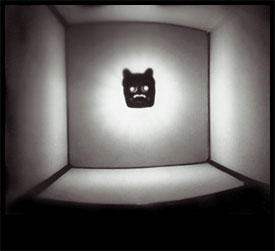
This being my first experience with pinhole photography I was impressed with the demonstration in the gallery. There was a small hole poked in a wall, all of the windows were taped shut and the lights off. the only light source was coming from this tiny hole. Upon my entrance there was nothing to be seen, just this jet of light spearing in the hole. Then we were asked to hold up a piece of large paper and wait several minutes for our eyes to adjust to the darkness in the room. After a few moments the image appeared on the sheet of paper. It was an upside down image of the courtyard outside.
I'm still not quite sure how exactly this is achieved but it was very impressive. When we took down the piece of paper the image was projected on the wall on the other side of the room. The image was much more fuzzy and without knowing what it was I doubt I would have been able to identify it, nevertheless it was interesting seeing the image change as we moved the paper closer and further from the hole and observed it's change.

Saturday, January 27, 2007
Candle Burning as a method of timekeeping

In 980 AD King Alfred the Great used burning candles to tell time. This technique was developed in monestaries where monks would burn candles to space out times for prayer. However this method is credited to King Alfred. Notches were often made down the candle to represent sections of the day. The job of watching the candle and sounding the bell when it was time for prayer was a very important job which was highly respected in the monestary.
Monday, January 22, 2007
Response to James Turrell
 I think the most interesting thing that James Turrell said was the last thing he said. he was talking about how when you read a book you must "pay the price of admission" for entering the world of that book. This seemed very interesting. he then mentioned that the price of admission for entering his crater project was that you would have to walk there, or so it seemed. This is something I have never seen in art before, usually people try to make their work assessable to as many people as possible, but to see somebody intentionally put their work out of reach to a large number of people and have that actually be a part of the work is highly unique and I feel that it will keep away a lot of whiny ignorant tourists.
As for everything else he spoke about, I didn't think much of it. Not to say it was bad or uninteresting, but it seemed that to have an appreciation for his work with light or the sky one must first have an interest in light or the sky, which I do not. Perhaps if i were to go visit one of these locations or to see one of his pieces in person I would think differently.
 Inside view of the crater project
Heyy!

WOOO! I'm blogging! woah! look at me!
I'm the most ludicrously modern techno-man in the world!
ZOMGZ!
Subscribe to:
Comments (Atom)
